
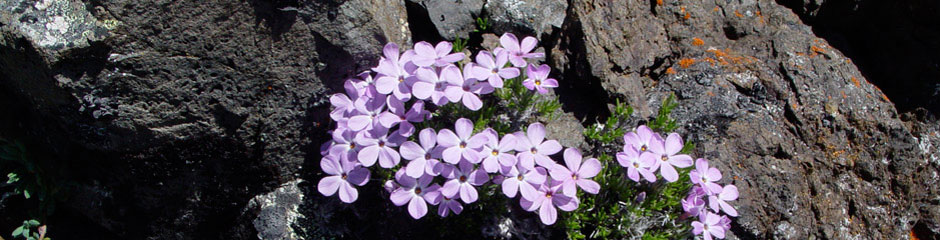

SCILLA LITARDIEREI
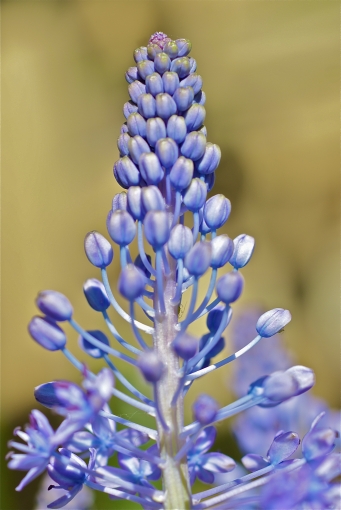
In my limited experience attending VIRAGS meetings (distance prevails against regular attendance), I have been struck by the number of plant goodies that piggyback their way into the church basement. At the recent meeting, a plant arrived courtesy of President Marion Espin. I was quite attracted to it and at the end of the meeting put in the winning bid. It was labelled Scilla hougiana by Marion. This lovely in flower bulbous plant was grown by Marion from seed from David Rose circa 1977. Probing into the nomenclature I could find nothing until I changed the spelling and looked into synonyms. The description in the RHS Dictionary of Gardening matched it to a T. It appears that the real ID on the silent auction Scilla is litardierei.
Scilla litardierei was authored by Maurice Breistroffer (abbreviated as Breistr.) who lived from 1910-1986 and published the accepted name and decription in the Bull. Mens. Soc. Linn. Lyon xxiii. 129 as recently as 1954. According to the International Plant Names Index (IPNI) synonyms of Scilla litardierei include S. amethystina and S. pratensis. The reference to 'hougiana' undoubtedly refers to Dutch bulb man, Michael Hoog. He was likely the collector of this form as designated by the "name". Given the rather recent authoring of the plant relative to Marion recieving the seed from Rose, it is easy to understand the nomenclatural problems. Hoog has also collected another form of this species from Yugoslavia. This would be a form of S. litardeirei named 'Orjen' after the mountain range in Montenegro (of the former Yugoslavia) that it hails from. According to many reports and descriptions 'Orjen' is not as robust as the form (type) that Marion grew. Brian Mathew notes different forms and habits of this species (see below).
It is worth noting that in an extensive trial at the RHS, Scilla litarderei received an AGM in 2004. It is a lovely plant that begins to flower in late Spring when there is often a lull in flowering between the Spring bulbs and the pure Summer flowering types. This was one of the comments that I glommed onto when talking to Marion at the meeting. It is a terrific trait. The flowers are borne in profusion on good sized stalks. This is not a dainty bulb but rather one with a lot more oomph. As such, it will work really well with perennials. The flowers are campanulate in nature and a lovely violet blue. See the pictures that show the density of the flowers and the buds having a purplish tint before opening. I was able to access all of the trial notes from the RHS website. Below are some of the notes regarding Scilla litardeirei.
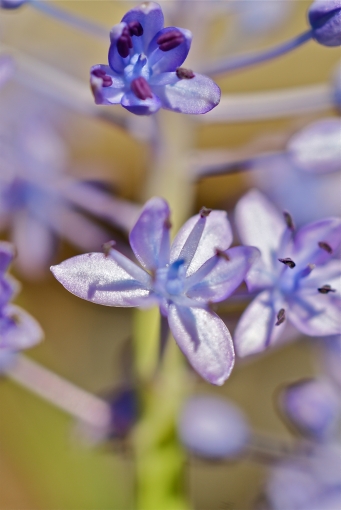 Some of the RHS Trial notes: Leaves: 8-10, upright to horizontal, to 13cm (5") long, 1cm wide, linear to strap-shaped, mid green (138A) above, slightly paler (137B) reverse. Flowering stem: 1-2, upright, 10- 17cm (4"-8") long. Scape: yellow-green (144A), 5- 13.5cm (2"-5") long. Raceme: conical, 2.5-5cm long, 2.5- 4cm wide bearing approx. 50 flowers. Pedicels: to 1.5cm long, purple- violet (82D to 94D), horizontal to slightly ascending. RHS comments: "A fine garden plant although variable in flower colour (shades of violet-blue) and aspect of the leaves (some with erect foliage others more spreading). Easy to grow and one of the latest to flower. The cultivar ‘Orjen’ is also good with richly coloured flowers, almost prostrate leaves and flowering mid-season." (Brian Mathew).
Bulb god, Martyn Rix, notes (p. 56 "Growing Bulbs" Helm, London 1983) that this is a karst (limestone) loving species found from the Dalmatian coast to Corfu. This bodes well for open garden planting especially here in the sandstone at my Yellow Point garden/nursery.
Grahame Ware